

Moving with storage means that a removal company collects your contents, stores them temporarily in secure containers and delivers them to your new address at a later date. You use it when the handover of your old and new homes does not line up. One company arranges the transport, the storage and the second move.
In practice, a few questions come with it. When do you really need storage? What do you pay per month? And what should you watch out for before you sign? In this article you can read how moving with storage works, what it costs and which pitfalls to avoid. If you want to know straight away what we offer, take a look at our page on storage of goods.
When do you need storage during a move?
Storage is needed as soon as there is a gap between the moment you leave your old home and the moment your new home is ready. That gap can last a week, but also half a year. These are the five situations we come across most often.
1. Your new-build home is completed later
New-build projects regularly run late. Weather conditions or material shortages can push the completion date back two or three months just like that. Your old home has already been sold by then, or your tenancy is coming to an end. With storage you bridge that period without your contents ending up in the loft at a relative’s house.
2. You are renovating first
A new kitchen, a new floor or a complete renovation: in an empty home the work goes faster and more cheaply. Many buyers therefore put their contents into storage for six to twelve weeks and only move in once the dust has settled.
3. Your old house is sold before you have found something new
In a tight housing market, houses sell quickly. Sometimes faster than you can find a new home. In that case you move in temporarily with family or rent something small, while most of your belongings are in storage.
4. You are emigrating or in an in-between period
Are you going abroad for work for a year, or waiting for a definite emigration date? Then selling your contents is often a shame. Storage per month is cheaper than buying everything again when you return.
5. You are downsizing to a smaller home as an older person
Anyone moving from a family home to a flat or care home cannot fit everything into the new space. Deciding what can go takes time, certainly when there are memories attached. Storage gives you that time. For a move for older people we often plan the storage room by room, so the family can sort things through at their own pace.
How does contents storage work during a move?
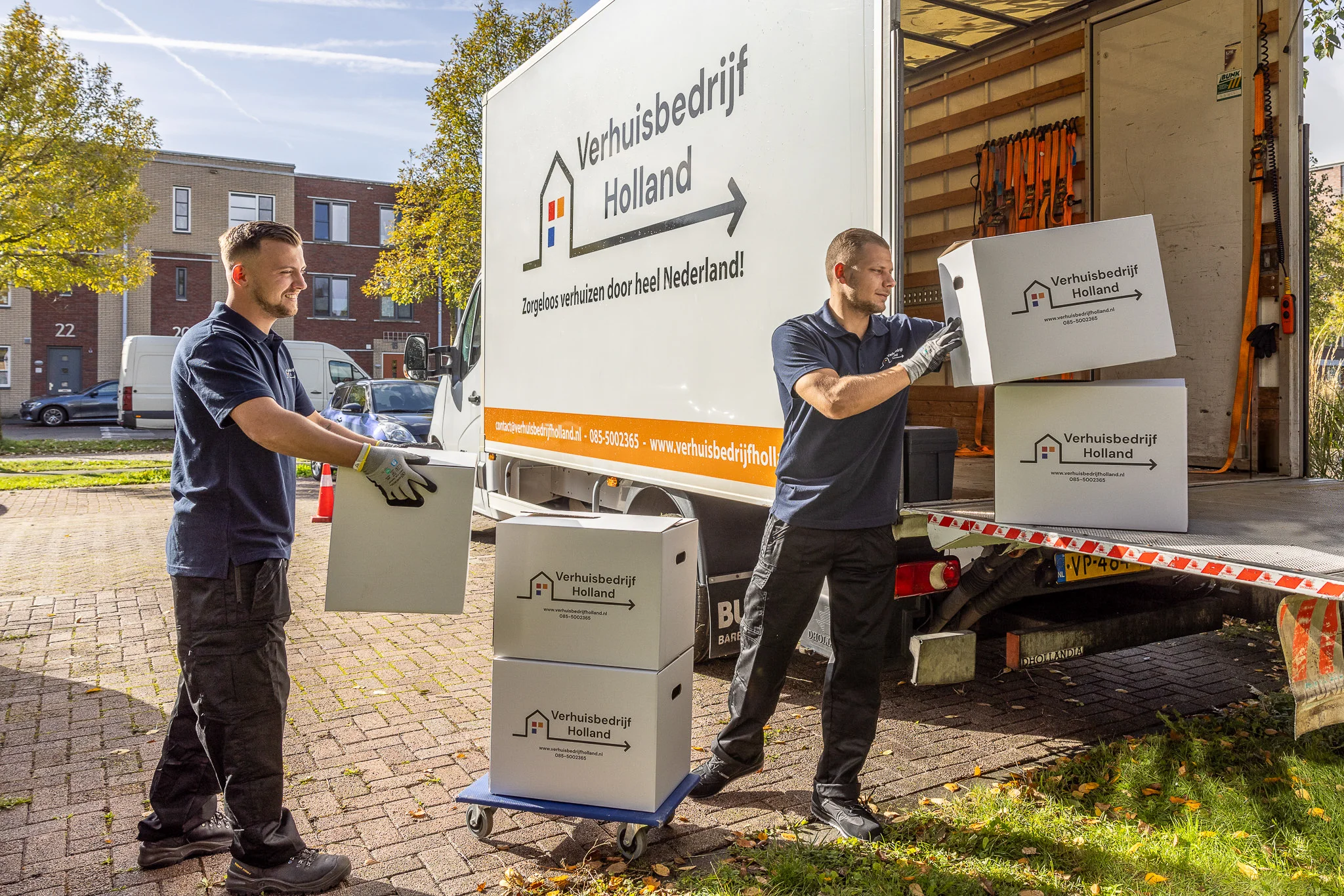
Contents storage through a removal company works with wooden removal containers of roughly 10 m³ each. On moving day the movers load your belongings straight into those containers. The containers then go into the storage warehouse sealed.
The big difference with self-storage is that you do not have to lift or drive anything yourself. The same team that empties your home puts the containers into the warehouse and delivers them to your new address later.
This is what the process looks like step by step:
- Inventory. You let us know online or by phone what needs to be moved. For larger contents, someone comes round for a survey.
- Loading and sealing. On moving day the movers wrap everything in blankets, load the containers and seal them on the spot.
- Storage period. The containers stand in a dry, secure warehouse. You pay per container per month.
- Delivery. As soon as your new home is ready, you schedule a date. The movers deliver everything and put the furniture in place.
Your contents are insured during transport and storage through the company’s removal goods insurance. Always ask, though, about the insured amount per container.
What does moving with storage cost?
Expect € 50 to € 90 per container per month for the storage itself, depending on the volume. An average family’s contents fit into three to five containers. That brings you to € 150 to € 450 per month in storage costs.
On top of that come the removal costs. An average move costs € 750 to € 1,300, depending on the location, the volume and the floor. With moving with storage you are in effect moving twice. Removal companies therefore price the combination on a quotation basis, often with a discount because the loading and the storage happen in one movement.
These factors determine the price:
- Volume of your contents. More cubic metres means more containers and more man-hours.
- Duration of the storage. Bridging a month costs little, a year adds up.
- Distance and access. A drive-in home loads faster than a flat on the third floor with no lift.
- Additional services. A packing service, dismantling of furniture or a furniture hoist.
Our page on the cost of a move explains all the price factors.
What should you look out for when choosing storage?
A cheap warehouse that turns out to be damp will cost you a sofa or a cupboard in the end. Check these four points before you agree.
Dry and temperature-controlled. Wood, leather and electronics do not cope well with damp and frost. Ask whether the warehouse is insulated and how the humidity is managed. A heated or frost-free space is worth considering for longer storage.
Insurance and sealing. Check what amount is insured per container and what you need to do to make a claim. Sealed containers give extra certainty: the seal proves that no one has touched your belongings.
Flexible term. A completion date easily slips by a month. Choose a provider where you can extend by the month without a penalty or a long minimum term.
All-in-one or carrying it yourself. Self-storage seems cheaper per month, but you hire a van as well, carry everything twice and bear the risk of damage. With a removal company, transport, storage and insurance come in one package. On our storage page you can see exactly how we have set this up.
Practical tips for moving with storage
A few preparations make the difference between order and chaos when unpacking.
- Do not store perishable or hazardous items. Food, plants, gas bottles, paint and batteries do not belong in a container. Food attracts pests and gas bottles are simply prohibited.
- Keep a case of essentials outside the storage. Think of documents, medication, chargers, seasonal clothing and a few days’ worth of kitchen items for your temporary stay.
- Label by room and number your boxes. Write the destination in the new home on every box and keep a list. That way everything goes straight into the right room on delivery.
- Take photos of valuable items. Handy for the insurance and for your own records.
- Ask how interim access works. Sealed containers do not, as a rule, open during the storage period. So do not put doubtful cases in the container.
Are you moving a complete home and want to know what else is involved? Then also read our page on the private house move.
Temporarily no roof over your belongings?
Moving with storage takes the time pressure off your move. Your contents wait dry, insured and sealed until your new home is ready, and the same team delivers everything again.