
Our services
Moving a piano
Moving a piano costs on average € 150 to € 450 within the same region, and a grand piano from € 350. Verhuisbedrijf Holland moves pianos and grand pianos expertly throughout central and western Netherlands.
What does moving a piano cost?
Moving a piano costs on average € 150 to € 450 within the same region. Moving a grand piano starts at € 350, because it requires more people and equipment.
If the piano has to go up or down stairs without a lift, a surcharge is added on top of the basic rate.
The price mainly depends on four things: the weight of the instrument, the number of stairs at both addresses, the distance between the old and new home, and how easy the front door is to reach. A piano that has to go through the window on a furniture lift costs more than one that simply rolls onto the tail lift.
Movers charge an hourly rate of € 35 to € 55 per person. For a standard piano move with two people, you should allow two to three hours, including packing and securing.

Request your free quote
Tell us briefly what needs to be moved and you will quickly receive a clear, tailored quote along with a dedicated contact who thinks along with you. You will hear from us within 24 hours, with a clear price upfront and no surprises afterwards. You can also come to us with questions about packing, storage or a furniture lift.
- A response within 24 hours
- One dedicated contact from start to finish
- Fully insured, with a clear price upfront

Why is a piano not an ordinary piece of furniture?
A piano weighs between 150 and 500 kilos, and that weight sits in the wrong place. The cast-iron frame and the strings are at the back and top of the instrument. As a result, the centre of gravity is high and a piano tips over more easily than you would expect. Anyone who lifts a piano like a cupboard is in for a surprise.
Together the strings are under a tension of some 18,000 kilos. The mechanism that strikes those strings consists of thousands of small wooden and felt parts. A sharp jolt can knock hammers out of alignment, cause strings to slip or disturb the tuning. Damage to the mechanism often only shows when you start to play.
The woodwork is just as vulnerable. The high-gloss finish of a piano scratches at the slightest contact with a door frame or banister. The legs and pedals break off if you lift by them. So never lift a piano by protruding parts, but always by the underside of the case or with lifting straps.
How do you prepare for a piano move?
Start by measuring. An average upright piano is around 150 centimetres wide and 60 centimetres deep. Measure all the doors, hallways and stairwell bends along the route, at both the old and the new address. A piano that is three centimetres too wide for the bend in the stairs is not something you want to discover on moving day.
Also check the lift, if there is one. Many lifts have a maximum load capacity of 300 to 400 kilos. With a piano plus two movers, you soon exceed that. In that case the instrument goes via the stairs or through the window on a furniture lift.
Clear the route and protect the floor with walkboards or cardboard. Fasten or lock the keyboard lid so that it cannot flip open while lifting. Pack the pedals separately with foam rubber.
Check your insurance beforehand. If you move it yourself, your contents insurance usually does not cover damage to the piano. A registered removal company is insured against transport damage, but always ask about this before you sign. If your new home is not yet ready, the piano can go into heated storage for a while. Large temperature swings are bad for the wood.

How do professional movers handle a piano?
Professionals place the piano on a piano dolly: a low steel trolley with rubber wheels that spreads the weight and spares the floor. The instrument is first fully wrapped in moving blankets and secured to the dolly with tension straps. That way nothing can shift or rub while it is being driven or rolled.
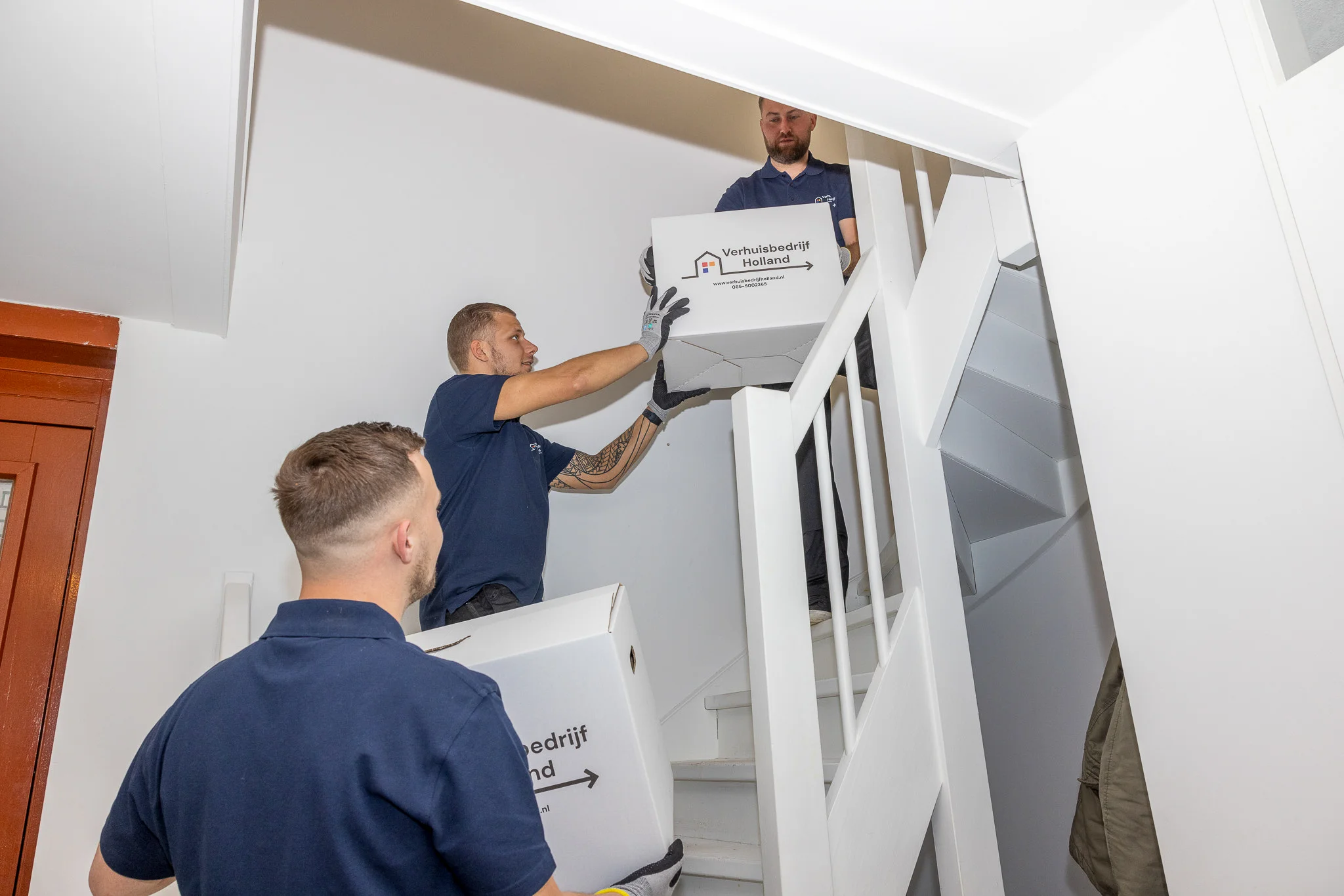
Lifting is always done with at least two people, and with three or four for stairs or a grand piano. Lifting straps under the case keep the hands free and spread the weight across the shoulders. One person steers and counts down while the rest follow. Working slowly is faster here than rushing.
On stairs there is one fixed rule: the heaviest side of the piano always points downwards. That way the instrument cannot tip away from you. For long or steep stairs, movers use an electric stair climber, which takes the piano up or down step by step in a controlled way. If the piano does not fit through the stairwell, it goes through the window or balcony on a furniture lift.
A grand piano is handled differently. The legs and the lyre are removed, after which the instrument is secured on its side on a grand piano board. Our teams in Utrecht and elsewhere move pianos and grand pianos in this way every week.
Move your piano yourself or leave it to us?
An honest answer: you can move a piano yourself, but only in a favourable scenario. Is the upright piano on the ground floor, is it going to a ground floor, and do you have four strong helpers plus a hired piano dolly and a van with a tail lift? Then it is doable. Work calmly, use lifting straps and secure the instrument in the van against the side wall.
In three situations we advise against it. With stairs and no lift: the risk of tipping is too great for inexperienced lifters, both for the instrument and for yourself. With a grand piano: dismantling it and laying it on its side takes experience you will not pick up from a video. And with an antique or valuable piano: the damage from a single slip outweighs the saving of a few hundred euros.
Factor in the risk as well. A slipped disc or a piano that slides down the stairs costs more than the € 250 to € 450 a professional charges. If you do move the rest of your household contents yourself, you can have just the piano done. That is also possible as part of a complete private move.

When should you have your piano tuned after the move?
Wait two to four weeks before tuning after a piano move. The wood, the floating soundboard and the tuning pins first need to get used to the temperature and humidity of the new room. If you have the tuner come sooner, the tuning will drift again within a few weeks and you will pay twice.
Choose the spot in the house with care. Do not place the piano against a radiator, underfloor heating without an insulating board, an outside wall or a large window. Changes in temperature and moisture make the wood move, and you can hear that in the tuning. An interior wall in a room with humidity between 45 and 60 per cent is ideal.
A tuning session costs on average € 90 to € 130 and takes a good hour. So schedule that appointment only a month after moving day. Feel free to play in the meantime; that does no harm.
Transporting your piano safely? Here is how
Moving a piano comes down to three things: knowing what it costs, measuring the route in advance and taking the weight seriously. Expect € 150 to € 450 within the same region, with a surcharge for stairs without a lift. You can handle a favourable situation yourself with four helpers; for stairs, a grand piano or a valuable instrument, leaving it to the professionals is the sensible choice.
Verhuisbedrijf Holland moves pianos and grand pianos throughout central and western Netherlands, on their own or as part of a complete move.
Based in Utrecht, active throughout the Netherlands
Our home base sits centrally in the country, in the Utrecht region. That is exactly why we are quickly on the scene everywhere: we handle removals throughout the Netherlands, from within the city to the other side of the country.
Recommended by those who have already moved
“Vanwege een verbouwing van onze woonkamer moesten onze meubels en piano verhuisd, opgeslagen en weer terugverhuisd worden. We vonden dit spannend omdat de piano een kostbaar instrument met emotionele waarde is.…”
 Marjolein N4 maanden geleden
“Ontzettend fijne en goed georganiseerde verhuizing gehad met Mohamed en team van Verhuisbedrijf Holland. Buitengewoon goede communicatie vooraf en tijdens de verhuizing. In totaal 7 wagens vol en allemaal op 1 dag over.…”
 Niels Verlinden6 maanden geleden
“Alles ging heel soepel en tot nu toe bij uitpakken geen schade getroffen. De mannen werkten goed door en gingen goed om met enkele antieke meubelstukken. Bedden uit- en weer in elkaar gezet. Was ook erg handig om…”
 Jackie Senior6 maanden geleden
“Keurige en professionele verhuizers. Eigenaar vriendelijk, denkt mee, flexibel en komt afspraken na. Met andere woorden: goede prijs/kwaliteitverhouding. Ik heb een vlotte verhuizing achter de rug waarbij mijn spullen…”
 Jane Booij4 maanden geleden
“Al 2x gebruikt gemaakt van hun diensten, en absolute toppers! Hebben me niet alleen met de verhuizing geholpen maar 7 enorme kledingkasten gedemonteerd en weer opgebouwd en geholpen verhuisafval weg te brengen. Echt…”
 Mevrouw Red4 maanden geleden
Frequently asked questions
What does it cost to have a piano moved?
Having a piano moved costs € 150 to € 450 within the same region. The price depends on the weight, the number of stairs and the distance between the two addresses. For a grand piano you pay from € 350, because more people and special equipment are needed. Movers charge an hourly rate of € 35 to € 55 per person, and a standard piano move takes two to three hours. Ask for a fixed price in advance, giving the type of piano and the floor it is on, and you will not be caught out by surprises.
What does moving a grand piano cost?
Moving a grand piano costs from € 350 and can rise to € 700 or more with stairs and long distances. A grand piano is heavier and more fragile than an ordinary piano and calls for three to four movers. The legs and the lyre are removed, after which the instrument is secured on its side on a grand piano board. That dismantling and reassembling takes extra time, and you see that reflected in the price. Because every grand piano is different, we prepare a tailored price after a short assessment.
Can you move a piano yourself?
You can move a piano yourself, but only in a favourable scenario: an upright piano on the ground floor, four strong helpers and a hired piano dolly with a van that has a tail lift. In that case, work calmly, use lifting straps and secure the instrument in the van against the side wall. With stairs and no lift, a grand piano or a valuable piano, we strongly advise against it, because the risk of tipping is high. A piano that slides down the stairs or a slipped disc soon costs more than the € 250 to € 450 a professional charges. If you are in doubt, leaving it to the professionals is almost always the cheaper choice in the long run.
How many people do you need to lift a piano?
For an upright piano on the ground floor you need at least two experienced lifters, preferably three. For stairs or a grand piano, three to four people are needed to spread the weight of 150 to 500 kilos safely. One person gives directions, counts down and keeps an eye on the route while the rest follow. Never lift with too few people, because the centre of gravity of a piano is high, so the instrument tips over more easily than a cupboard of the same weight. Professional movers use lifting straps under the case to keep their hands free and spread the weight across the shoulders.
How do you move a piano up or down stairs?
On stairs there is one fixed rule: the heaviest side of the piano always points downwards, so that the instrument cannot tip away from you. For long or steep stairs, movers use an electric stair climber, which takes the piano up or down step by step in a controlled way. The instrument is first fully wrapped in moving blankets and secured on a piano dolly. If the piano does not fit through the stairwell, it comes in through the window or the balcony on a furniture lift. Inexperienced lifters often underestimate how dangerous stairs are with such a high centre of gravity, so it is best to leave this to the professionals.
Should I have my piano tuned after the move?
Yes, but wait two to four weeks before tuning after a piano move. The wood, the soundboard and the tuning pins first need to get used to the temperature and humidity of the new room. If you have the tuner come sooner, the tuning will drift again within a few weeks and you will pay twice. A tuning session costs on average € 90 to € 130 and takes a good hour, so schedule that appointment a month after moving day. You are free to play in the meantime; that does the instrument no harm.
How is a piano protected during transport?
A piano is first fully wrapped in thick moving blankets and then secured to a piano dolly with rubber wheels using tension straps. That dolly spreads the weight and spares both the instrument and your floor. The keyboard lid is locked or fastened so that it cannot flip open while lifting, and the pedals are packed separately with foam rubber. In the van the piano stands upright against the side wall, again held against shifting with tension straps. For a valuable instrument, check in advance whether the removal company’s transport insurance covers the piano.
Can a piano go into temporary storage?
Yes, a piano can go into temporary storage, but only in a heated and dry space. Large swings in temperature and humidity make the wood move, which is bad for the tuning and the mechanism. So for a move where your new home is not yet ready, we store the piano in a climate-controlled storage unit. Never put a piano in an unheated garage or shed, not even for a few weeks. After the storage period, let the instrument acclimatise for two to four weeks again before you have it tuned.